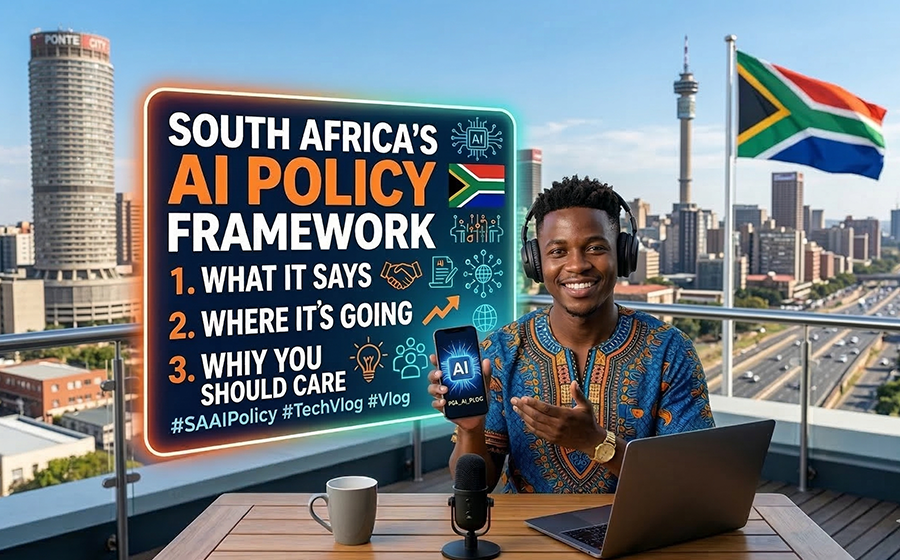
If you've been following the global AI conversation, you'll know that countries around the world are scrambling to figure out how to regulate artificial intelligence. The EU has its AI Act. The US has its executive orders. China has its own approach. And South Africa? We've been working on ours too quietly, and not without some bumps along the road.
In October 2024, the Department of Communications and Digital Technologies (DCDT) published the South Africa National Artificial Intelligence Policy Framework. It's not a law. It's not even a final policy. It's a framework, a set of guiding ideas intended to shape what eventually becomes our National AI Policy and, in the long run, a comprehensive AI Act.
As of early 2026, that full draft policy has cleared several government approval hurdles and is expected to be gazetted for a 60-day public comment period very soon, with finalization targeted for the 2026/2027 financial year. So this is a living process, and now is exactly the right time to understand what's in it.
Let's break it down without the jargon.
What Is This Framework, Exactly?
Think of it as a government conversation starter. The framework is a 13-page document from the DCDT that lays out the big-picture rationale for why South Africa needs an AI policy, the problems it should address, and the key focus areas (or "pillars").
It positions AI as a general-purpose technology — on par with electricity or the internet — with the potential to transform our economy and society. The core message is that South Africa needs to embrace AI's potential while managing the risks it entails, especially given our unique challenges around inequality, access to technology, and historical socioeconomic divides.
The framework was opened for public comment with a deadline of 29 November 2024. Since then, organizations such as Mozilla, law firms, academic institutions, and civil society groups have provided feedback.
The Big Ideas: What the Framework Covers
The framework is built around several strategic pillars. Here's a plain-language rundown of what they're getting at:
Talent and Skills Development: South Africa needs more people who understand AI. The framework calls for integrating AI education into school and university curricula, creating specialised training programmes, and building partnerships between universities and industry. This is arguably the most important pillar; you can't build an AI-ready economy without the people to drive it.
Digital Infrastructure: AI requires computing power and a fast, reliable internet connection. The framework pushes for investment in super-computing infrastructure, 4G, 5G, and high-capacity fiber networks. For anyone who's experienced the reality of connectivity in many parts of South Africa, this one is both aspirational and essential.
Research, Development, and Innovation: The framework envisions dedicated AI research centers, public-private partnerships, and financial incentives for AI startups. It's about building a local AI ecosystem rather than just consuming AI products made elsewhere.
Public Sector Implementation: Government wants to use AI to improve how the state works; streamlining administration, improving service delivery, and setting standards for how AI gets used in the public sector.
Ethics, Privacy, and Fairness: Several pillars deal with the ethical side of AI. The framework calls for guidelines on responsible AI use, strengthened data protection (building on POPIA), transparency in how AI systems make decisions, and active efforts to identify and reduce bias in AI systems. It also emphasizes a human-centered approach, meaning AI should support human decision-making, not replace it.
Safety and Security: This covers cybersecurity protections for AI systems and risk management frameworks to address the threats posed by deploying AI at scale.
Cultural Values and Professional Responsibility: The framework aims to ensure that AI development reflects South African values—promoting well-being, equality, and sustainability. It also calls for a code of conduct for AI professionals and ethics training baked into AI education.
What's Good About It
Credit where it's due. Before this framework, South Africa was notably absent from the global AI policy conversation. Countries across the continent, Kenya, Rwanda, and Mauritius, had already begun putting their frameworks in place. So the fact that the DCDT has started this process is a meaningful step.
The framework takes a sensible approach by recognizing that one set of rules won't work for every sector. Healthcare, education, finance, and agriculture all face different AI challenges. The document advocates for sector-specific strategies tailored to each industry's unique needs.
The emphasis on human-centred AI and ethical principles is also well-placed. In a country with deep socioeconomic divides, the risk that AI could entrench or amplify existing inequalities is real. The framework acknowledges this directly, calling out the digital divide, historical inequities, and the need for inclusive access to AI benefits.
The "Futures Triangle" approach used in the framework, looking at the push of the present (economic and technological pressures), the pull of the future (where we want to be), and the weight of the past (what's holding us back), is a thoughtful way to frame the problem. It's honest about the challenges South Africa faces, including institutional inertia and outdated regulatory frameworks.
What's Been Criticised
The framework has received fair criticism from several quarters, and it's worth being honest about the gaps.
It's high-level, with few specifics. At 13 pages, the framework outlines principles but lacks actionable steps, timelines, key performance indicators, and budget allocations. That's partly by design; it's a framework, not the final policy. But it still leaves many open questions about how any of this gets implemented in practice.
The process has been bumpy. Multiple commentators have noted that the framework was initially released without much fanfare and was difficult to find on the DCDT's website. Transparency around how the document was developed, who contributed, and what methodology was used has been limited. For a framework that talks a lot about transparency, the irony hasn't gone unnoticed.
It doesn't connect well with existing efforts. The framework doesn't reference the DCDT's own AI Planning Document released earlier in 2024, the AI Institute of South Africa (AIISA) announced in 2022, or international frameworks such as the African Union's AI Strategy or UNESCO's AI ethics recommendations. This has made the overall AI policy effort seem a bit fragmented.
The timeline has been slow. The process kicked off with a National AI Summit in April 2024, followed by the planning document, then the framework in August/October 2024, and now, in early 2026, the full draft policy is only just approaching Cabinet approval. Finalisation is expected in 2027 at the earliest, with actual implementation likely from 2027/2028. In a field that moves as fast as AI, that's a long time to wait. Some industry observers have expressed concern about whether the policy will be outdated by the time it's finally in place.
Where Things Stand Now — March 2026
Here's the latest: On 24 February 2026, the DCDT briefed Parliament on the progress of the Draft National AI Policy. The good news is that it has cleared the Socioeconomic Impact Assessment System (SEIAS) certification and achieved agreement across all Director-General clusters, meaning it has broad inter-departmental support.
The draft is now moving through Cabinet approval and is expected to be gazetted for a 60-day public consultation period soon. Once the consultation is complete and the feedback is integrated, it returns to Cabinet for final approval. From there, sector-specific strategies and supporting regulations are expected to follow from 2027/2028.
One important development: the government has confirmed it will not create a single, centralised AI regulator. Instead, AI oversight will be distributed among existing regulatory bodies, with ICASA mentioned as one authority likely to play a role. This means AI governance will be woven into existing frameworks for data protection, cybersecurity, and sector-specific regulation, rather than being managed by a single new entity.
Minister Solly Malatsi has acknowledged that the process has been slower than ideal but has pointed to the complexity of South Africa's multi-layered consultation requirements. He's also noted that the rapid evolution of AI since the first draft was published has made ongoing refinement necessary.
Why This Matters for Developers, Businesses, and Everyday South Africans
If you're a developer, this framework is an early signal of the guardrails to come. AI ethics, data governance, algorithmic transparency, and bias mitigation aren't just abstract concepts; they're likely to become compliance requirements. Getting ahead of this now, understanding the principles, and building responsible AI practices into your workflow is smart.
If you run a business that uses AI from chatbots to recommendation engines to automated decision-making, you should be paying attention. The multi-regulator approach means that, depending on your industry, your existing regulator may soon have AI oversight responsibilities. Reviewing your current AI deployments and governance structures is a practical step you can take now.
And if you're an everyday South African who uses AI tools (and you probably do, whether you realise it or not, from your phone's autocomplete to your bank's fraud detection to content recommendations on social media), this policy will shape how those systems treat your data, make decisions about you, and operate fairly.
The upcoming 60-day public comment period is a real opportunity to have your say. When it opens, the draft will be available on the Government Gazette, and the DCDT will be accepting feedback. Whether you agree with the approach, think it's too slow, or have specific concerns about how AI affects your industry or community, that's the moment to make your voice heard.
Final Thoughts
South Africa's AI Policy Framework isn't perfect. It's broad where it could be specific, slow where the world is moving fast, and it has legitimate transparency issues. But it's also a necessary starting point. The alternative, no policy framework at all, while AI reshapes our economy and society, would be far worse.
The framework gets the big questions right: How do we embrace AI's benefits while managing its risks? How do we ensure the gains are shared, not just concentrated among those who are already ahead? And how do we do all of this in a way that reflects South African values and realities?
The answers will come in the detailed policy and eventual legislation. But the conversation is happening, and it's one every South African developer, business owner, student, teacher, and citizen should be part of.
Useful Links
- Download the SA National AI Policy Framework (DCDT)
- AI Policy and Regulation Timeline in South Africa (Ellipsis)
- SA AI Policy Moves Towards Approval — Baker McKenzie Analysis
- South Africa's AI Dilemma — ISS African Futures
- Download the gazetted Draft South African National Artificial Intelligence (AI) Policy



1 Comment
This policy must be accompanied with clear regulations on contravention of citizens rights using AI by private and public individuals and companies.. with severe consequences and punishment.. jail terms being imposed on individuals and company directors if proven .. I also recommend the same for communication license holders ECNS/ ECS .. then we can have the likes of starlink enter the market
Leave a Comment
Your email address will not be published. Comments are reviewed before appearing.